If you're ordering custom merchandise for the first time, start by writing down five things: purpose, item, quantity, deadline and design file. The numbers don't need to be exact. Something like “hair ties to hand out at an event, around 300, by the 20th of next month, logo file ready” is enough to confirm feasibility and schedule right at the first consultation.
kory has planned its own hair rollers, hair ties, claw clips, scarves, neck pillows, slippers and hourglasses and made them together with factories. This article lists, in order, the things we found “would have been faster if we'd decided them first.”
What should you decide first?
| What to decide | Example | Why it matters |
|---|---|---|
| Purpose | Handing out at an event / selling in a shop / gifts for staff or members | Weight, size and packaging change |
| Item | Hair ties, scarves, neck pillows | Check whether the recipient will keep using it |
| Quantity | About 50, around 300 | Minimum quantities differ by item |
| Deadline | Event date, the date you need it by | The sample schedule is worked out backwards |
| Design file | Original logo file, or else your largest image | It determines print quality |
What changes depending on the purpose?
Merchandise you hand out should be light and compact so recipients can carry it home easily. Merchandise you sell needs an individual box and a barcode (the striped code that reads the product number) before it can go on a shop shelf. For gifts, the first impression when the box is opened matters. Even for the same item, packaging and finish change with the purpose.
Which item should you choose?
We first ask, “Will the recipient keep using it?” Merchandise received at an event and thrown away, and merchandise taken home and used every day, give different results on the same budget. That's why kory makes things people actually use in daily life, like hair ties, claw clips, scarves, neck pillows and slippers. There are two ways to make them.
| Method | What's involved | Best for |
|---|---|---|
| Building on an existing product | Change only the logo and colors on an item already in production | First orders, tight schedules |
| Making from scratch | Choose a new item and create new drawings, samples and box dielines | When the item you want isn't on the market |
For a first order, building on an existing product is the lighter option. The production process already exists, so it's the fastest. At kory, we don't charge a design fee for work that just adds a logo. When making from scratch, there may be costs depending on the scope of design, and we'll explain them up front during consultation.
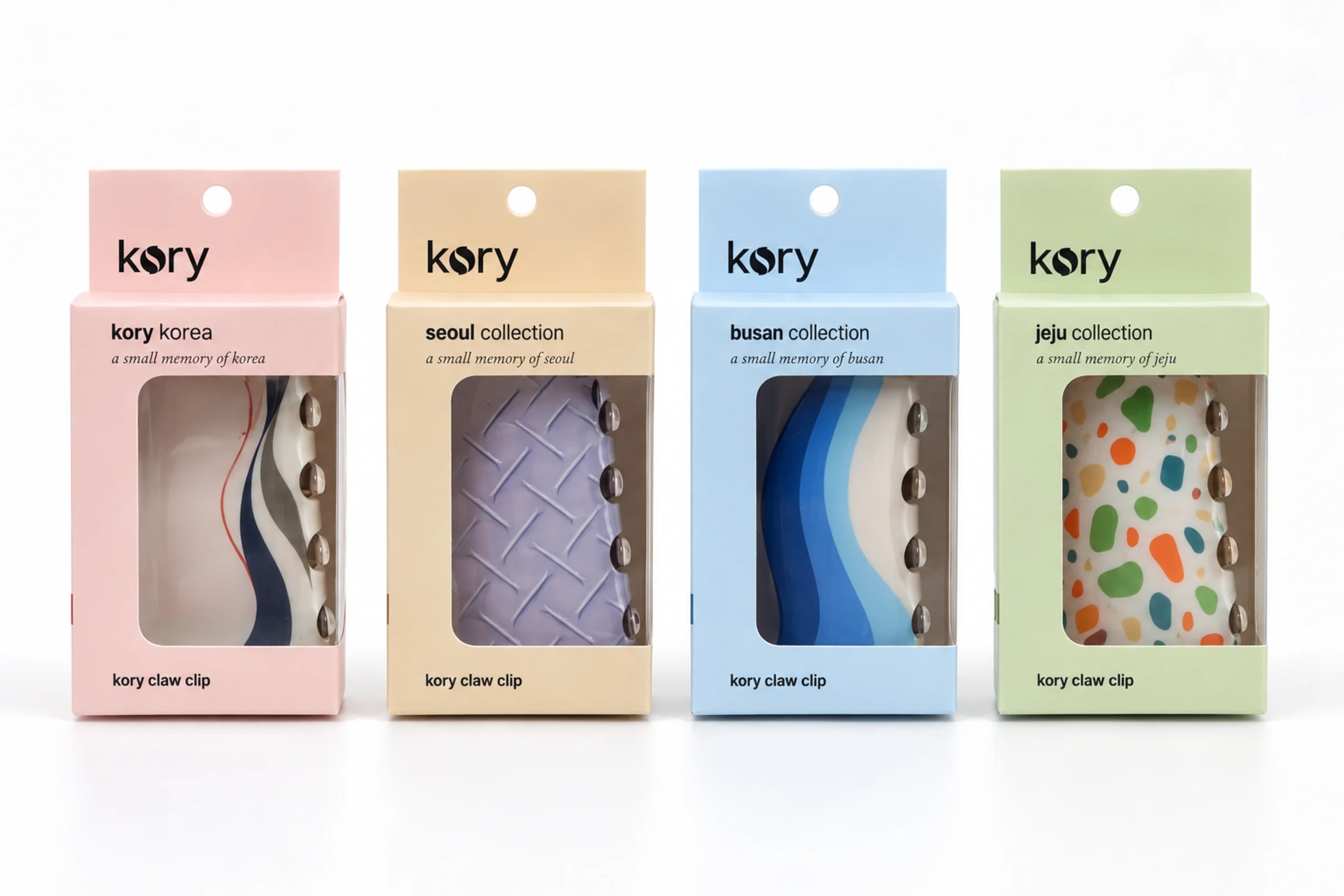
You can also make several versions of one item. Like the claw clips above, keep one shape and change only the pattern and box color, and you can hand out different versions by branch or department.
How few can you order?
The minimum order quantity (the smallest number that has to be made in one run) differs by item, because a rubber hair tie and a glass hourglass are made in completely different ways. So kory doesn't set a single minimum; we let you know once we hear which item you want. Small quantities are open for discussion too. When you inquire, a range like “about 50” or “around 300” is fine instead of an exact number.
When can you receive it?
It usually takes 4–6 weeks after the design and quantity are confirmed. Adding a logo to an existing product is the fastest. The most common problem in custom merchandise is not receiving it in time for the event. If your event date is set, tell us in your first inquiry. We'll work backwards from that date to schedule the sample (a single piece made in advance to check).
What design file should you send?
As a rule, the client provides the logo or artwork file. An original file whose lines stay smooth when enlarged (the vector file designers use) gives clean printing. If you don't have the original, send the largest image you have. Where the logo goes on the item, and at what size, we decide together during consultation.
What are the steps from inquiry to delivery?
- Inquiry — tell us the purpose, rough quantity and the date you need it by.
- Feasibility and quote — we check unit price and schedule based on the item and quantity, and reply.
- Design and sample — the design is finalized, and if needed you see the real thing as a sample.
- Production — after confirmation, it's made over 4–6 weeks, and we keep you updated on progress.
- Delivery — you receive finished products in individual boxes. A tax invoice is issued.
If you're curious what actually gets written and sent to the factory, see “What Goes in an OEM Production Request?”as well.
The hardest part of making merchandise for the first time is not knowing what to say first. Write the five things on a single note, and the conversation moves quickly from the very first contact.
Frequently asked questions
What's the minimum order for custom merchandise?
It differs by item, so there's no single number. Tell us the item you want to make and a rough quantity, and we'll check and let you know. Small quantities are open for discussion too.
How long does custom merchandise take to produce?
Usually 4–6 weeks after the design and quantity are confirmed. Adding a logo to an existing product is the fastest, so if you have an event date, let us know in your first inquiry.
Can I ask you to do the design too?
As a rule, the client provides the design file. That said, simple work like adding a logo is done without a design fee.