A production request — the document you send a factory when you commission a product — has four parts: specifications, design, item codes and barcodes, and inspection standards. This article turns what kory actually wrote for its seven products into a checklist a small brand can follow as is.
Why do you need a production request?
OEM means another company's factory makes products under your brand. The brand sets the design and the standards; the factory does the making. If you only ask verbally, each side remembers it differently. "A nice blue" is a different blue to everyone.
A production request closes that gap with numbers and words. If the goods arrive different, it is your basis for saying "it says so right here." kory made one sheet per product — seven in all — written in Korean, Chinese and English.
The four sections at a glance
| Section | What to write | kory example |
|---|---|---|
| Specifications | Materials, dimensions and tolerances, contents, packaging, case quantity | Hair roller — PP core with Velcro, 40mm diameter (±2mm), 2 per box |
| Design | Colours and patterns for each version, production method | Hair tie letters — engraved and colour-filled, not printed |
| Item codes and barcodes | Product numbers, a separate barcode for each option | KRY0001 format; the slippers need 24 barcodes |
| Inspection standards | Common standards + product-specific standards | AQL 2.5 random inspection; neck pillow holds air for 24 hours |
What goes in the specifications?
Materials, dimensions, contents and packaging. Two things are easy to miss.
- Tolerance. The range within which a difference is acceptable. Every factory-made piece varies slightly, so without a range you cannot say where a defect begins. The smaller the item, the tighter the range.
- Case quantity. How many units go in one outer carton. It becomes the unit you deliver to shops in, so it helps to set it early.
| Product | Tolerance |
|---|---|
| Hair tie pendant | ±1mm |
| Hair roller | ±2mm |
| Slippers | ±3mm |
| Scarf | ±10mm |
Packaging is part of the specifications too: box size, window shape, hang hole, even what is printed on the back. The kory neck pillow is not inflated by mouth, so we decided to print pump instructions on the back of the box.
Should the design section include how it is made?
Yes. If you describe only the look, the factory may choose an easier method. For the letters on the kory hair tie pendants we wrote "engraved, then colour-filled" rather than printed. Letters cut as grooves and filled with colour do not rub off easily. They look alike at first, but the difference shows with long use.
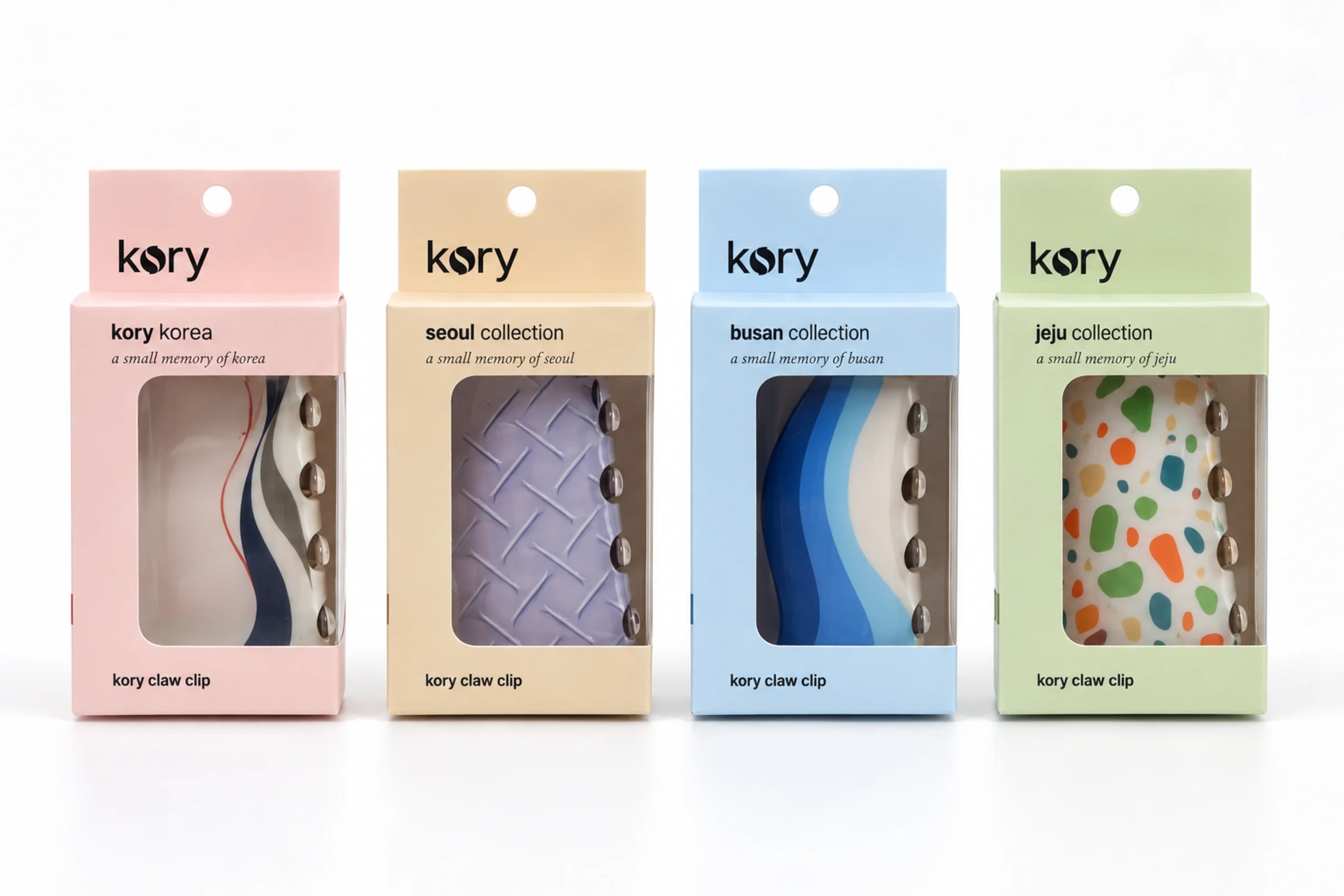
If there are several versions, write what differs for each. kory makes every product in four versions — Korea, Seoul, Busan and Jeju — so we listed the base colour, pattern and box colour city by city. For the claw clip we added one line: "the pattern continues onto the inner surface." Without it, the inside could arrive plain white.
Why set item codes and barcodes at the factory stage?
So that every box leaves the factory with the right barcode already on it, and nobody has to stick labels on one by one after delivery. Each option needs its own barcode. kory slippers come in four cities, two colours and three sizes, so they need twenty-four barcodes.
How do you write inspection standards?
Separate the common standards that apply to every product from the standards specific to each one.
Common standards
- Colour, print and shape match the approved (golden) sample
- No foreign matter, sharp edges, dents or stains
- Every box carries a barcode, quality label and country of origin
- Random inspection at AQL 2.5 before shipping, with defects replaced
Product-specific standards
Write them around what the product has to do. The less you can tell by looking, the more you should fix a time or a number of cycles.
| Product | Test |
|---|---|
| Hair roller | Stays in the hair without pins |
| Hair tie | Returns to shape after stretching to twice its length |
| Claw clip | Survives 1,000 openings and closings |
| Scarf | Does not fade or shrink much when washed |
| Neck pillow | Holds air for 24 hours after inflating |
| Slippers | Left and right match in size and colour |
| Sand timer | Sand runs out in 5 minutes, within ±15 seconds |
A final checklist before you send it
- Is there a tolerance for every dimension?
- Did you specify the method — printed or engraved?
- Are the differences between versions listed separately?
- Does every option have a barcode?
- Have you named the approved sample?
- Is there at least one test matched to what the product does?
- Is it also written in the factory's language?
There is one rule: write down even the obvious. What is obvious to a brand may not be obvious to the factory.
Frequently asked questions
Is a production request different from a product specification sheet?
The specification sheet is one part of the production request. The specification sheet sets materials, dimensions and shape; the production request adds design, item codes and barcodes, and inspection standards, defining what you will receive and how it will be checked.
How do you set tolerances?
The smaller the item, the tighter the tolerance. kory set ±1mm for the hair tie pendants, ±2mm for the hair rollers, ±3mm for the slippers and ±10mm for the scarves. Without a written range, there will be disputes over where a defect begins.
What is AQL 2.5?
An international standard for checking a set number of randomly drawn units instead of every item. If defects among them exceed the set number, the lot fails. 2.5 is a level commonly used for everyday goods.